
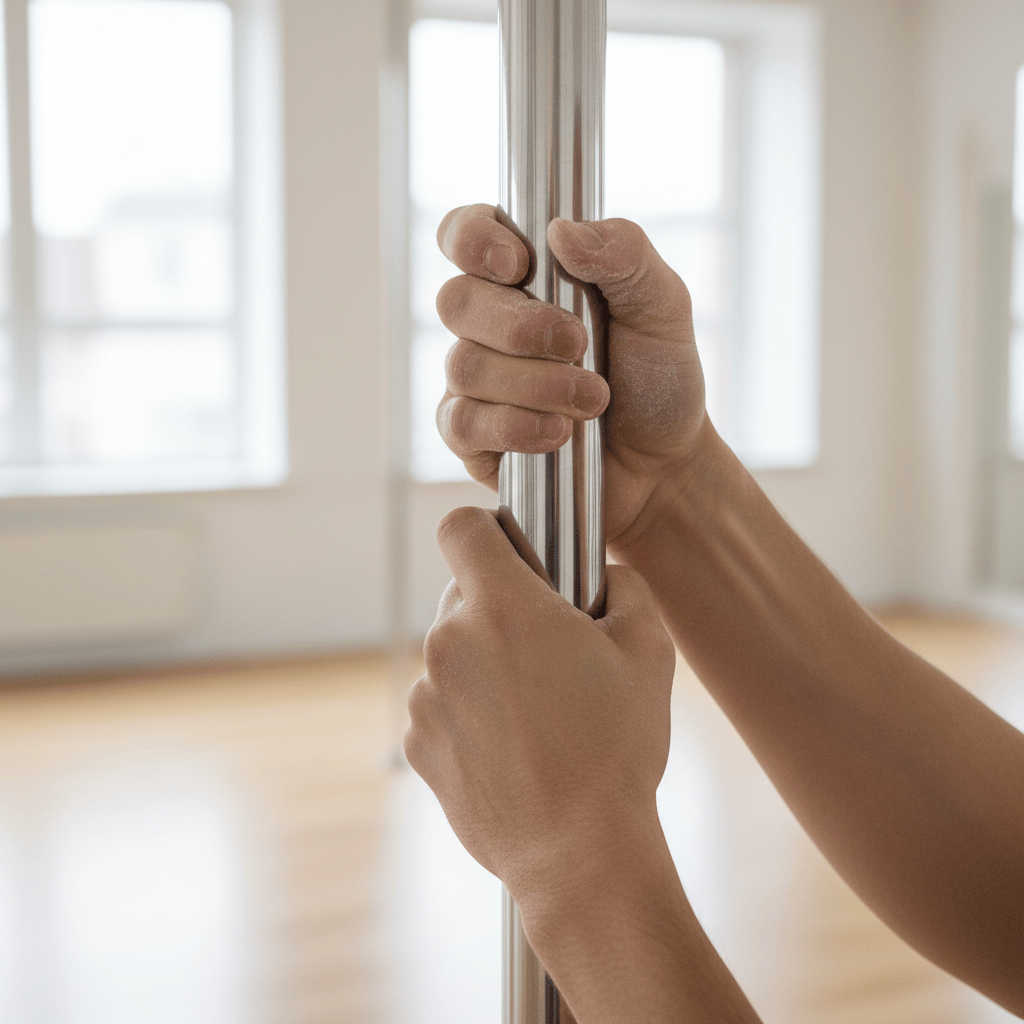
Let's talk about something that might seem simple but is absolutely GAME-CHANGING for your aerial journey: grip strength.
Whether you're working toward your first climb, nailing inversions, or flowing seamlessly across the pole, grip is your foundation. It's the silent hero that makes everything else possible. And here's the good news - grip strength is trainable, improvable, and something you can work on both in class AND at home.
Let's dive into the science, the practical tips, and how to keep your hands healthy while you're building serious grip power.
Why grip matters (more than you think)
Your grip isn't just about holding on. It's about:
Performance: Every move you do on the pole relies on your grip. Climbs, spins, holds, transitions - they all start with your hands. Better grip = more control, smoother movement, and the ability to attempt moves you've been dreaming about.
Safety: A strong grip is an injury-prevention superpower. When your hands are strong, you're less likely to slip, less likely to compensate with other body parts, and more likely to catch yourself if something goes wrong. It's literally your safety net.
Confidence: There's something magical that happens when you trust your grip. You stop second-guessing yourself mid-move. You commit fully. You FLOW. And that confidence spills into everything you do on the pole.
Progression: Want to progress faster? Grip strength is often the bottleneck. Students with strong grips progress through levels quicker because they can focus on technique and artistry instead of just holding on.
The science behind grip strength
Your grip involves multiple muscle groups working together:
- Forearm muscles (flexors and extensors) do most of the heavy lifting. These are the muscles that actually squeeze and hold.
- Hand muscles (intrinsic muscles) provide fine motor control and stability.
- Finger strength matters more than you'd think. Each finger needs to be strong enough to support your body weight.
- Nervous system adaptation is huge. When you first start aerial, your nervous system isn't efficient at recruiting muscle fibres. With practice, your body learns to use its muscles more effectively - so you get stronger without necessarily building more muscle.
The cool part? Grip strength is one of the fastest things to improve in aerial fitness. You can see noticeable changes in 2-3 weeks of consistent training.
Common grip mistakes (and how to avoid them)
Mistake #1: Gripping too hard
Squeezing with all your might sounds like it would help, but it actually tires your hands faster and can lead to injury. The goal is efficient grip - using just enough pressure to stay safe while conserving energy.
Fix it: Focus on engaging your forearm muscles rather than death-gripping with your fingers. Your instructor can help you find the sweet spot.
Mistake #2: Neglecting finger strength
Your fingers do a LOT of work, but many students focus only on their palm and forearm. Weak fingers = slower progression and higher injury risk.
Fix it: Include finger-specific exercises in your training (not sure how? Don't worry, there's more on this below!).
Mistake #3: Skipping warm-ups
Cold hands are weak hands. Starting class without properly warming up your hands and forearms means you're working at 70% capacity from the jump.
Fix it: Always warm up! Shake out your hands, do some wrist circles, maybe do a few dead hangs or grip exercises before class starts.
Mistake #4: Not listening to your hands
Pain, numbness, tingling, or excessive fatigue are signals. Pushing through can lead to serious injuries like tendonitis or nerve compression.
Fix it: Communicate with your instructor. Rest when you need to. Your hands will thank you.
Mistake #5: Training grip without recovery
Grip strength training is intense. Your hands need recovery time just like any other muscle group.
Fix it: Don't do heavy grip training every single day. 3-4 times per week is ideal, with rest days in between.
Building grip strength: exercises you can do
In class: Every aerial class naturally builds grip strength. But you can maximise it by:
- Focusing on proper hand placement
- Engaging your forearms consciously
- Asking your instructor for grip-specific modifications
- Staying for the full class (don't skip early!)
At home (15-20 minutes, 3-4x per week):
1. Dead hangs
If you have a pull-up bar or sturdy door frame, hang from the bar with straight arms. Start with 10-20 seconds and work up to 60+ seconds. Rest 1-2 minutes between sets and do 3-5 sets. Why it works: this builds serious grip endurance and finger strength.
2. Finger hangs
Same as dead hangs, but use only your fingers (not your whole hand). Start with 5-10 seconds, work up gradually, and do 3-5 sets. Why it works: targets individual finger strength, which is crucial for aerial.
3. Grip trainer or stress ball squeezes
Squeeze and hold for 5 seconds, then release. Repeat 15-20 times for 3 sets. Why it works: builds hand and forearm strength in a controlled way.
4. Wrist curls (with light weights or water bottles)
Hold a light weight in your hand, palm down, and curl your wrist up and down slowly. 15 reps, 3 sets per arm. Why it works: strengthens the forearm muscles that support grip.
5. Reverse wrist curls
Same as above, but palm facing up. 15 reps, 3 sets per arm. Why it works: balances forearm strength and prevents injury.
Pro tip: Do these exercises AFTER class or on rest days, not before. You want fresh hands for aerial training.
Injury prevention: protecting your hands
Strong grip is great, but protecting your hands is equally important.
Signs of overuse:
- Persistent soreness (beyond normal muscle fatigue)
- Numbness or tingling in fingers
- Swelling or inflammation
- Pain that doesn't improve with rest
- Weakness that's getting worse, not better
If you experience these, STOP and tell your instructor. Tendonitis, nerve compression, and other hand injuries can sideline you for weeks or months if ignored.
Prevention strategies:
- Warm up properly before every class
- Cool down and stretch your hands and forearms after class
- Take rest days (your hands need recovery time!)
- Ice your hands if they're sore (15 minutes, a few times a day)
- Wear grip gloves if your studio offers them (they reduce friction and protect your skin)
- Listen to your body - pain is information
Recovery tips:
- Massage your forearms and hands daily
- Stretch your wrists and fingers (hold each stretch for 30 seconds)
- Use a foam roller on your forearms
- Stay hydrated (dehydration makes muscles tighter)
- Sleep well (this is when your body repairs itself)
The timeline: what to expect
Week 1-2: Your hands will be sore. This is normal! You're building calluses and teaching your nervous system to work harder. Keep showing up.
Week 3-4: You'll notice you can hold on longer. Moves that felt impossible start to feel possible. Your grip is adapting.
Week 5-8: Real strength gains. You're progressing faster. Moves that took weeks to learn are becoming smooth.
Week 9-12: You're amazed at what your hands can do. Grip is no longer your limiting factor - technique and confidence are.
3+ months: Grip strength becomes a non-issue. You're thinking about artistry, flow, and advanced moves instead of just holding on.
Your grip journey starts now
Here's the truth: grip strength is one of the most trainable aspects of aerial fitness. You don't need to be naturally strong. You just need to be consistent.
Show up to class. Do your home exercises. Listen to your body. Rest when you need to. And trust the process.
In a few weeks, you'll catch yourself holding onto something and thinking, "Wow, my grip is actually strong now." That moment? It's the best. 💪
And remember - every single instructor you admire started exactly where you are. They just kept showing up.